Table of Contents
ToggleConstruction sites get hit with theft every day. Special events need crowd monitoring. Property owners facing temporary security gaps can’t always justify the cost and hassle of permanent camera installations. That’s where mobile security camera trailers come in, self-contained surveillance units you can rent by the week or month, drop anywhere, and monitor remotely. They’re solar-powered, weather-resistant, and surprisingly capable. Whether you’re managing a renovation, hosting an outdoor event, or securing vacant land, understanding how these trailers work and what to look for in a rental will save you time, money, and headaches.
Key Takeaways
- A mobile security camera trailer rental is a portable, solar-powered surveillance solution that deploys in minutes without permanent installation, making it ideal for construction sites, events, and temporary security gaps.
- Choose trailers with at least 1080p HD cameras, 100+ feet night vision range, and 300+ watts of solar capacity with large battery banks to ensure continuous off-grid operation and reliable coverage.
- Expect to pay $200–$600 per week or $600–$2,000 per month for mobile security camera trailer rentals, with additional costs for delivery, setup, cellular data, monitoring services, and equipment insurance.
- Verify cellular coverage at your site, test the monitoring platform interface before committing, and confirm 24/7 technical support availability to avoid costly downtime during your rental period.
- Review rental contracts carefully, comparing multiple providers on equipment age, maintenance records, response protocols, and cancellation policies to find the best value and lowest total cost of ownership.
What Is a Mobile Security Camera Trailer?
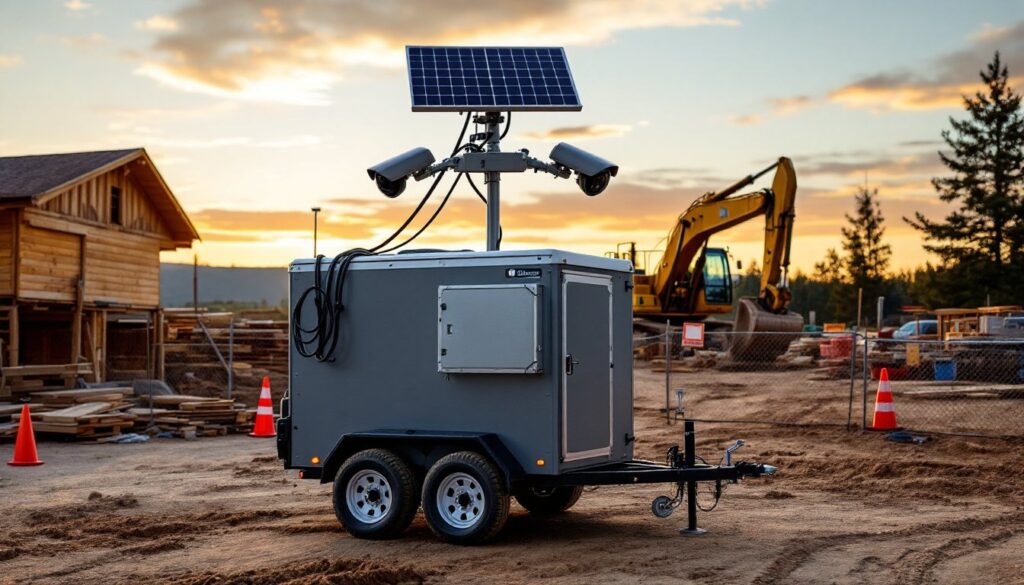
A mobile security camera trailer is a portable surveillance system mounted on a wheeled trailer chassis. These units combine high-definition cameras, wireless transmission equipment, onboard power systems, and sometimes floodlights or speakers into a single towable package. Most stand 8 to 12 feet tall when the telescoping mast is extended, giving cameras an elevated vantage point that’s tough to tamper with.
The typical setup includes one to four PTZ (pan-tilt-zoom) cameras capable of 360-degree rotation and night vision up to 150 feet or more. Power comes from a combination of solar panels (usually 200-400 watts) and onboard battery banks, allowing these trailers to operate off-grid for days or weeks depending on weather and usage. Cellular modems or Wi-Fi hotspots transmit live video feeds to cloud platforms, so you can view footage from a phone or computer anywhere with internet access.
Units are designed for quick deployment. You tow them with a standard vehicle (most require a 2-inch ball hitch), position them on level ground, extend the mast, and power on. No trenching for cables, no electrician, no permanent mounting. When the job’s done, you collapse the mast and tow it away. Rental companies handle maintenance, troubleshooting, and often provide 24/7 monitoring services if needed.
When Do You Need a Mobile Security Camera Trailer Rental?
Construction Sites and Renovation Projects
Construction theft costs the industry billions annually. Tools, copper wire, building materials, and heavy equipment vanish overnight, especially on projects without fencing or lighting. A mobile camera trailer parked at the site entrance or near material stockpiles acts as both deterrent and evidence collector. Many models include two-way audio and strobe lights that activate on motion detection, letting you issue verbal warnings to trespassers in real time.
Renovation projects on occupied properties benefit too. If you’re managing a multi-week remodel and workers are coming and going, a trailer monitors access points, protects staged materials, and provides liability documentation. It’s particularly useful for exterior work, roofing, siding, landscaping, where the worksite is exposed to street traffic. Expect to run the unit for the duration of the project plus a week or two after final inspections, when sites are most vulnerable.
Special Events and Property Monitoring
Outdoor events, festivals, fairs, parking lot sales, weddings on private land, often require temporary security to manage crowds, deter vehicle break-ins, and document incidents. A single trailer can cover multiple acres depending on camera specs and mast height. Event organizers use footage to coordinate security staff, review disputes, and meet insurance or permitting requirements.
Property monitoring scenarios include vacant land sales, estate cleanouts, agricultural sites during harvest, and seasonal facilities (campgrounds, sports complexes) during the off-season. If you’re holding an estate sale and expect high foot traffic over a weekend, a rental trailer provides both security and liability protection. According to security technology analysis, modern surveillance systems with remote monitoring capabilities have become more accessible and cost-effective for temporary applications. For rural properties or lots without power access, the off-grid capability is a dealbreaker advantage.
Key Features to Look for in a Rental Unit
Start with camera resolution and coverage. Look for units with at least 1080p HD cameras: 4K models are increasingly common and provide better zoom detail for license plates or faces. PTZ functionality is non-negotiable for large areas, fixed cameras are cheaper but cover far less ground. Check the night vision range: infrared or starlight sensors should deliver usable footage in total darkness out to 100+ feet.
Power autonomy matters more than most renters realize. A trailer with 300+ watts of solar and a 200-amp-hour battery bank will run continuously in most climates, even with cloudy stretches. Units with smaller panels or batteries may require generator backup or AC hookup, which defeats the portability advantage. Ask the rental provider for real-world runtime data, not just specs.
Connectivity options determine how you access footage. Cellular LTE modems are standard and work in most locations, but confirm coverage at your site, rural or industrial areas can have dead zones. Some units offer dual-SIM setups for redundancy. Wi-Fi-only trailers are cheaper but require you to provide a hotspot or nearby network, which isn’t practical for remote sites. Cloud storage plans vary: check if the rental includes rolling video storage (typically 7-30 days) or if you pay extra per gigabyte.
Durability and weatherproofing are critical if you’re deploying in harsh conditions. Look for trailers with IP66 or IP67-rated enclosures, rust-resistant chassis, and surge-protected electronics. Wheels should have functional brakes and bearings: renters who’ve dealt with flat tires or seized axles mid-project know the headache. If you’re in a high-wind area, ask about anchoring systems, sandbags, ground stakes, or wheel chocks, to prevent tip-over.
Finally, consider add-ons and monitoring services. Some providers offer remote monitoring by trained personnel who alert you to intrusions and can dispatch authorities. Others include motion-triggered floodlights, audible alarms, or two-way intercom for active deterrence. Reviews on home service platforms often highlight the importance of responsive customer support when technical issues arise. These features cost extra but can make the difference between catching a theft and just recording one.
How Much Does Mobile Security Camera Trailer Rental Cost?
Rental pricing varies widely based on features, location, and contract length, but expect to pay $200 to $600 per week or $600 to $2,000 per month for a standard unit. Entry-level trailers with single fixed cameras and basic cellular connectivity land on the lower end. High-end models with multiple PTZ cameras, 4K resolution, integrated lighting, and professional monitoring services push toward the upper range.
Delivery and setup fees typically add $100 to $300 to the first billing cycle, depending on distance and terrain. Some providers include free delivery within a local radius (often 25-50 miles) but charge mileage beyond that. Setup is usually straightforward, driver drops the trailer, extends the mast, and verifies connectivity, but complex installations (uneven terrain, special anchoring, custom camera angles) may incur additional labor charges.
Monthly contracts offer better per-day rates than weekly rentals. If your project runs three months, negotiate a flat monthly rate rather than paying week-by-week. Many companies also waive or reduce delivery fees for longer commitments. Conversely, daily rentals exist but are rare and expensive, often $100 to $200 per day, because of the logistics overhead.
Be aware of hidden costs. Cellular data plans are sometimes billed separately, especially if you exceed included bandwidth (common with continuous HD streaming or frequent playback). Damage waivers or insurance can add 10-15% to the rental cost. If the unit requires generator fuel or AC power hookup because solar isn’t sufficient for your location, that’s on you. Late return fees, cleaning charges for excessively muddy units, and equipment loss (theft or vandalism) can also hit your wallet.
Compare quotes from multiple providers and read the rental agreement carefully. According to smart home technology experts, understanding the total cost of ownership, including subscription fees and add-ons, is essential when evaluating any security system. Some companies bundle monitoring, cloud storage, and support into one price: others nickel-and-dime each service. Ask for an itemized estimate covering the full rental period, including all fees, so you can budget accurately.
How to Choose the Right Rental Provider
Start by confirming the provider services your area and can deliver within your timeline. National chains have broad coverage and standardized equipment, but local or regional companies may offer better rates, more flexible terms, and faster response for troubleshooting. Check online reviews and ratings, focusing on feedback about equipment reliability, customer service responsiveness, and transparency in billing.
Ask about equipment age and maintenance records. Trailers that have been in service for years without upgrades may have outdated cameras, weak batteries, or connectivity issues. A reputable provider will tell you the model year, recent service history, and any known quirks. Request photos or specs of the actual unit you’ll receive, not just generic marketing images.
Test the monitoring platform before you commit. Most providers offer a demo login or trial access. Make sure the interface is intuitive, video playback is smooth, and you can easily download clips if needed. Mobile app quality varies, some are clunky or crash-prone. If remote monitoring by security personnel is part of the package, ask about their response protocols, escalation procedures, and average response time.
Clarify support and troubleshooting terms. What happens if the unit loses power, connectivity drops, or a camera malfunctions? Is tech support available 24/7, or only during business hours? Will they dispatch a technician or swap out the unit, and is there a service call fee? Downtime on a construction site or during an event is costly, so prioritize providers with robust support.
Finally, read the rental contract carefully. Note the cancellation policy, liability for theft or damage, insurance requirements, and any clauses about equipment upgrades or substitutions. Some contracts auto-renew: others require advance notice to terminate. If you’re unsure about rental duration, choose a provider with flexible month-to-month terms rather than locking into a long-term agreement with penalties for early return.